
Left Main and Bifurcation Stenting: Understanding Complex Coronary Angioplasty
Table of Contents
- Introduction
- Complex Stenting At a Glance
- What Is the Left Main Coronary Artery?
- What Is a Coronary Bifurcation Blockage?
- Why Are Left Main and Bifurcation Procedures Considered Complex?
- Decision Support: Should I Choose Left Main Stenting or Bypass Surgery?
- How Is Left Main and Bifurcation Stenting Performed?
- Is One Stent or Two Stents Better for a Bifurcation?
- Why Is IVUS Important in Left Main Stenting?
- Who May Not Benefit From Left Main Stenting?
- What Are the Possible Risks of Left Main and Bifurcation PCI?
- Myth vs. Fact: Complex Stenting
- What Should You Do Next?
- Advanced Cardiovascular Care at CANES Clinic
- Key Points to Remember
- FAQs
Book a Consultation
Prevention is better than cure. Talk to our specialists today.
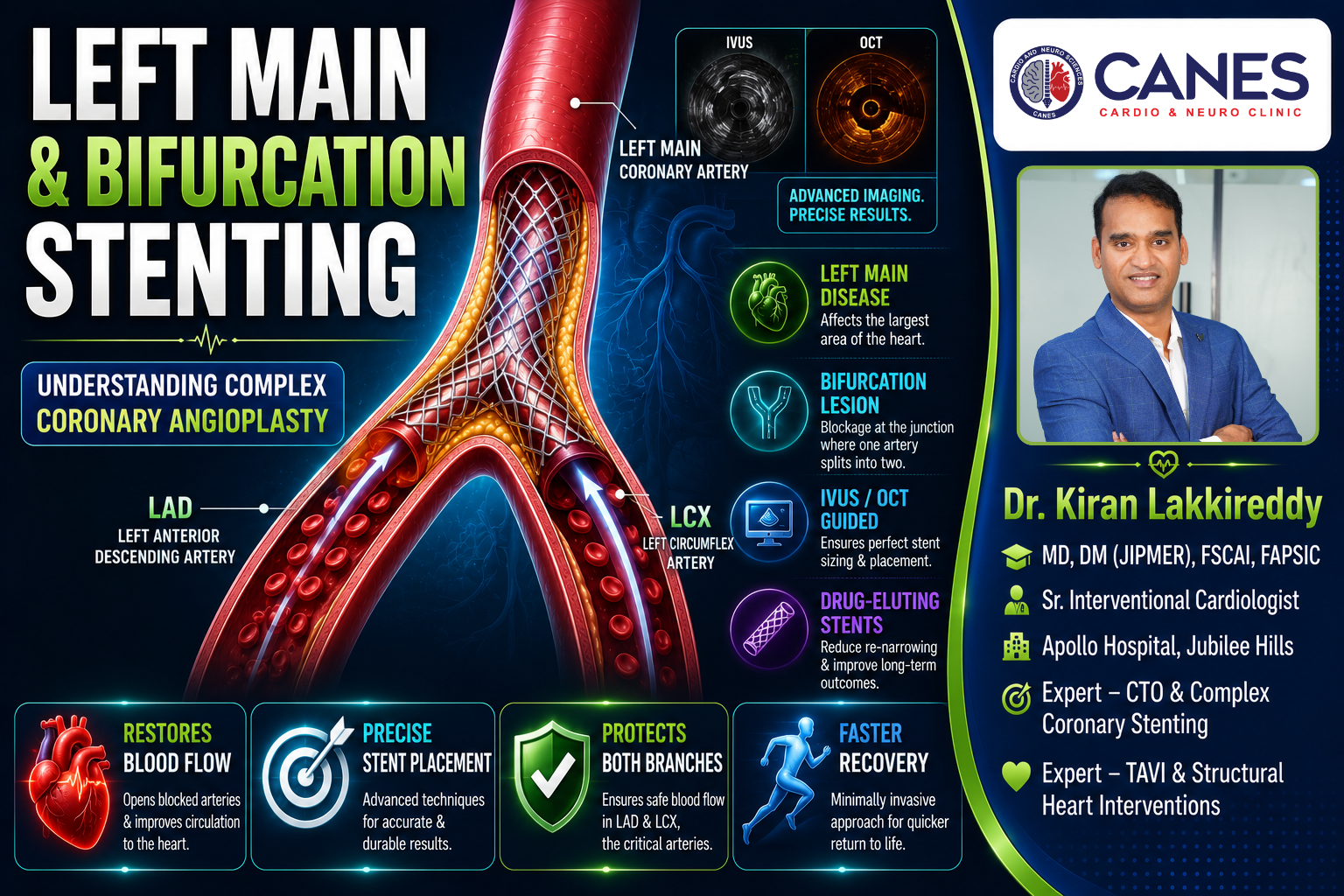
Coronary stenting is commonly used to open narrowed heart arteries and restore healthy blood flow. However, not every blockage is straightforward. When blockages occur in critical junctions of the heart, specialized techniques like left main and bifurcation stenting become necessary to protect your cardiovascular system.
Treating these high-risk locations requires meticulous planning because the cardiologist must open the blocked artery while simultaneously protecting blood flow to every other important branch. Modern drug-eluting stents, advanced imaging, and specialized surgical techniques have made minimally invasive treatment highly successful for carefully selected patients. However, stenting is not automatically the right option for everyone; the decision must be tailored to your specific anatomy, overall health, and long-term goals.
At CANES Cardio & Neuro Clinic, a specialized cardiovascular care center in Hyderabad, we believe that patients should clearly understand both their disease and their available treatment options. Guided by Dr. Kiran Lakkireddy, an experienced interventional cardiologist specializing in complex cardiology, our approach focuses on detailed assessment, shared decision-making, and structured follow-up care. In this guide, we explain exactly what left main and bifurcation stenting involves and how experts decide between placing a stent and performing bypass surgery.
Quick Answer
Left main and bifurcation stenting is a specialized form of coronary angioplasty used to safely treat blockages located in the heart’s primary artery or at an intersection where a vessel divides into two branches. The procedure uses advanced imaging and specialized stent placements to restore essential blood flow. Because this affects a massive area of the heart, treatment decisions are highly individualized, weighing the benefits of minimally invasive stenting against traditional bypass surgery.
Complex Stenting At a Glance
Feature | What It Means | Why It Matters |
|---|---|---|
Left Main Artery | The primary vessel supplying the left side of the heart. | A blockage here threatens a massive portion of the heart muscle. |
Bifurcation | A “fork in the road” where one artery splits into two. | Treating one branch risks accidentally shifting plaque into the other. |
IVUS / OCT | Microscopic cameras placed inside the artery. | Ensures the stent is perfectly sized and expanded for long-term safety. |
Provisional Stenting | Placing one stent first, and a second only if needed. | The safest, most common approach to keep procedures as simple as possible. |
What Is the Left Main Coronary Artery?
The left main coronary artery is the major blood vessel beginning at the aorta that divides into the left anterior descending artery (LAD) and the left circumflex artery (LCx), supplying blood to the largest portion of the heart muscle.
Key Takeaway: A left main blockage is considered extremely critical because it can threaten the blood supply to a massive area of the heart all at once, unlike a blockage in a smaller branch.
Detailed Explanation
Left main disease may develop at the very beginning of the artery, in its middle section, or near the intersection where it divides into the LAD and LCx. A blockage at the far end (distal end) of the left main artery is often the most complex to treat because it directly involves both branching vessels. The cardiologist must restore blood flow through the main pipe while avoiding the accidental obstruction of either the LAD or the LCx.
While a standard angiogram provides a basic outline of the coronary artery, estimating the true severity of some left main blockages from an X-ray alone can be difficult. For uncertain narrowings, cardiologists rely on advanced intravascular imaging or pressure-based assessments to determine exactly how severely blood flow is being restricted.
What Is a Coronary Bifurcation Blockage?
A coronary bifurcation blockage is a buildup of cholesterol plaque at a junction where one main blood vessel divides into two distinct branches, creating a Y-shaped intersection.
Key Takeaway: Bifurcation stenting is highly complex because inflating a balloon or opening a stent in one branch can physically push plaque into the neighboring branch, accidentally cutting off its blood supply.
Detailed Explanation
Imagine a major highway that divides into two important exit routes. If a road crew repairs the main highway without protecting the second route, they might accidentally push debris into the exit, closing it off completely.
A similar challenge occurs during bifurcation angioplasty. When a balloon or stent expands inside the main vessel, plaque can shift (often called the “snowplow effect”) toward the side branch. The metal structure of the stent itself may also cover the opening of that branch. To prevent this, the cardiologist meticulously plans how to maintain access to both branches, select the exact right stent diameter, and confirm that blood flows freely down both “roads” before finishing the procedure.
Why Are Left Main and Bifurcation Procedures Considered Complex?
These procedures are considered complex because they involve treating large arteries of varying sizes, navigating challenging vessel angles, and simultaneously preserving high-volume blood flow through multiple critical pathways.
Key Takeaway: Procedural success relies not just on placing a stent, but on selecting the correct architectural strategy and using advanced imaging to confirm the stent is structurally perfect.
Detailed Explanation
Standard stenting is often straightforward, but left main and bifurcation stenting introduces several high-stakes variables:
Large Muscle Area at Risk: Left main disease dictates the blood supply for both the LAD and LCx. A mistake here affects a massive amount of heart tissue.
Mismatched Vessel Diameters: A stent sized perfectly for a smaller branch may not fully expand to touch the walls of the larger main artery, leading to future complications.
Plaque Shifting: Expanding a stent in the main vessel can violently push hard plaque into the fragile side branch.
Heavy Calcium Deposits: Complex blockages often contain rock-hard calcium that prevents standard stents from opening completely unless the plaque is drilled or prepared beforehand.
Decision Support: Should I Choose Left Main Stenting or Bypass Surgery?
For patients with highly complex, extensive coronary disease, bypass surgery (CABG) is often the safest long-term option; however, for patients with less extensive disease or high surgical risks, left main stenting is a highly effective, minimally invasive alternative.
Current international cardiology guidelines emphasize shared decision-making. This means there is rarely a single “right” answer. A multidisciplinary Heart Team (including an interventional cardiologist and a cardiac surgeon) will review your specific anatomy to determine the best path.
If your anatomy is suitable, left main stenting offers a much faster recovery without opening the chest. However, if you are diabetic and have diffuse, heavily calcified blockages across multiple vessels, bypass surgery generally provides far superior, long-lasting durability.
Comparing Your Treatment Options
Consideration | Left Main Stenting (PCI) | Bypass Surgery (CABG) |
|---|---|---|
Invasiveness | Done via a tiny pinhole in the wrist or groin. | Requires open-chest surgery to create new vessel routes. |
Recovery Time | Fast; usually home within 24 to 48 hours. | Longer; requires weeks of rehabilitation and healing. |
Best Used For | Less extensive, localized anatomical blockages. | Highly complex, extensive, multi-vessel disease. |
Diabetes Impact | Requires highly individualized clinical assessment. | Often provides a distinct survival advantage for diabetics. |
How Is Left Main and Bifurcation Stenting Performed?
The procedure is performed by guiding micro-catheters to the heart, preparing the hard plaque, carefully placing a drug-eluting stent to hold the vessel open, and optimizing its shape using specialized balloons and imaging cameras.
Key Takeaway: This is a meticulous, multi-step process where preserving the side branch and ensuring the stent is perfectly molded to the artery wall are the highest priorities.
Detailed Explanation
While every patient is unique, the general procedural steps include:
Coronary Access: A catheter is inserted, typically through the radial artery in the wrist, and guided to the heart.
Wiring Both Branches: Fine, microscopic guidewires are passed into both the main vessel and the side branch to protect access if the side branch accidentally narrows during treatment.
Lesion Preparation: Hard, calcified plaque is cracked using balloons or calcium-modification drills so the new stent can expand fully.
Stent Placement: A drug-eluting stent is positioned across the blockage and expanded to create a stable blood channel.
Proximal Optimization (POT): A specialized balloon is inflated only in the upper portion of the stent to ensure the metal perfectly matches the larger diameter of the proximal artery.
Final Imaging: Intravascular cameras are used to verify that the stent is perfectly expanded, securely touching the artery walls, and leaving both branches wide open.
Is One Stent or Two Stents Better for a Bifurcation?
Expert consensus strongly supports a “provisional” one-stent strategy for most bifurcation blockages, meaning the main vessel is stented first, and a second stent is only placed into the side branch if it becomes compromised or severely narrowed.
Key Takeaway: Less metal is often better. Using a single stent reduces procedural complexity and long-term risk; two stents are only used when the specific anatomy demands it.
Detailed Explanation
When dealing with a bifurcation, cardiologists prefer to keep the architecture as simple as safely possible.
Provisional One-Stent Strategy: This is used for most uncomplicated lesions. The main vessel is fixed, and the side branch is left alone unless it loses blood flow.
Planned Two-Stent Strategy: If both the main branch and a very large side branch are severely diseased from the start, the cardiologist will plan to use two stents using specialized overlapping techniques (like DK-Crush, Culotte, or TAP stenting).
Rescue Stenting: A second stent is added reactively if a provisional one-stent approach unexpectedly causes the side branch to tear or close.
Why Is IVUS Important in Left Main Stenting?
Intravascular Ultrasound (IVUS) is a microscopic camera placed inside the artery that creates highly detailed cross-sectional images, allowing the cardiologist to ensure the stent is perfectly sized and fully expanded against the vessel wall.
Key Takeaway: An external X-ray (angiogram) only shows the shadow of the blood flow; IVUS allows the doctor to see the actual tissue and stent struts from the inside, significantly reducing the risk of future complications.
Detailed Explanation
The European Bifurcation Club and major cardiology guidelines heavily recommend using IVUS (or Optical Coherence Tomography – OCT) during complex left main and bifurcation stenting.
Because the left main artery is so large and vital, leaving a stent “under-expanded” (where the metal doesn’t firmly press against the artery wall) can lead to deadly blood clots (stent thrombosis) or rapid re-narrowing (restenosis). IVUS guarantees that the stent diameter matches the artery perfectly, that all calcified plaque is properly covered, and that there are no hidden tears at the edges of the stent.
Who May Not Benefit From Left Main Stenting?
Not every patient is a safe candidate for stenting. Patients with diffusely diseased, heavily calcified arteries across multiple vessels, or those who cannot safely take required long-term blood thinners, generally derive a much safer, longer-lasting benefit from bypass surgery.
Key Takeaway: Pushing to place stents in an environment that is too complex often leads to failure. A trustworthy cardiologist knows when to step back and recommend surgery for your ultimate safety.
Detailed Explanation
If your left main anatomy is extremely complex and involves multiple other diseased major arteries, attempting to place 5 or 6 complex stents carries a high risk of future failure. Furthermore, if you have a medical condition that prevents you from taking daily antiplatelet medications (blood thinners), placing a metal stent is highly dangerous, as it will likely clot. In these specific scenarios, prioritizing traditional bypass surgery provides a significantly better long-term prognosis.
What Are the Possible Risks of Left Main and Bifurcation PCI?
Like every coronary intervention, left main and bifurcation PCI carries risks including bleeding, vessel dissection, side-branch occlusion, heart attack, stroke, emergency surgery, restenosis, and stent thrombosis. However, careful patient selection, IVUS guidance, and experienced operators significantly reduce these risks.
Key Takeaway: An individual patient’s risk depends heavily on the urgency of treatment, anatomy, heart function, and kidney function, which is why procedure planning is meticulous.
Detailed Explanation
While complex stenting is highly successful, treating such critical arteries involves careful navigation. Expanding balloons or stents near a bifurcation can sometimes cause a “snowplow effect,” inadvertently narrowing the side branch (side-branch occlusion). There is also a small risk of a tear in the artery wall (dissection).
Over the long term, the primary risks are restenosis (renarrowing of the treated area) and stent thrombosis (a blood clot forming inside the metal stent). This is why adhering strictly to prescribed blood thinners and utilizing intravascular imaging (IVUS/OCT) during the procedure are so critical to ensure the stent is perfectly expanded and positioned.
Myth vs. Fact: Complex Stenting
Understanding the realities of left main and bifurcation stenting helps reduce anxiety and empowers you to make informed decisions.
Common Myth | Medical Fact |
|---|---|
Every left main blockage requires open-heart bypass surgery. | While bypass is important, selected patients with suitable anatomy can be treated highly effectively and safely with minimally invasive PCI. |
Every bifurcation needs two stents to be safe. | Most bifurcations are approached with one main-vessel stent. A second is only added if medically necessary, as less metal is generally better. |
Once the stent is placed, my heart disease is completely cured. | Stents open the blockage, but atherosclerosis is a lifelong disease requiring strict medication and lifestyle management to prevent new blockages. |
I can stop my blood thinners once I feel better. | Stopping prescribed antiplatelet medicines without explicit medical advice can cause a sudden, fatal blood clot inside the new stent. |
What Should You Do Next?
If you have been diagnosed with a complex left main or bifurcation blockage, take these immediate, actionable steps to protect your health:
Gather Your Imaging: Always request physical copies (CDs or USBs) of your angiograms. A second-opinion doctor must see the moving video, not just the paper report.
Ask About the Heart Team: Ensure your case has been reviewed by both an interventional cardiologist and a cardiac surgeon to guarantee unbiased advice.
Inquire About Intravascular Imaging: Ask your cardiologist if they routinely use IVUS or OCT during complex stenting to optimize the final result.
Review Your Medications: Confirm that you can financially and medically commit to taking dual antiplatelet therapy (blood thinners) uninterrupted for the required duration after stenting.
Advanced Cardiovascular Care at CANES Clinic
Complex coronary disease can create considerable anxiety for patients and families, particularly when choosing between stenting and bypass surgery. At CANES Cardio & Neuro Clinic, we prioritize clear patient education, meticulous assessment, and evidence-based decision-making.
Guided by Dr. Kiran Lakkireddy, a highly experienced interventional cardiologist and specialist in complex coronary architecture, our approach is designed to help you make informed decisions without feeling rushed. We utilize state-of-the-art intravascular imaging to ensure that if a stent is placed, it is placed with absolute precision. If you are facing a complex diagnosis, scheduling a structured, second-opinion evaluation is your most vital next step.
Location: 3rd Floor, Tapasavi Commercial Complex, Hi-Tension Road, Kondapur, Hyderabad
Contact: +91 9014944654
Appointment Booking: Visit CANES Clinic Official Portal
Specialist Profile: Dr. Kiran Lakkireddy Official Website
Key Points to Remember
Critical Anatomy: The left main artery is vital; it supplies blood to a massive portion of the heart through the LAD and LCx branches.
Branch Protection: Bifurcation stenting requires advanced techniques to preserve blood flow through both the main vessel and the side branch simultaneously.
Less is Often More: A one-stent provisional strategy is the preferred starting point. A second stent is added only when the anatomy absolutely requires it.
Precision Imaging: IVUS or OCT is strongly recommended in many complex left main and bifurcation procedures because it helps optimize stent sizing and expansion.
Stenting Isn’t for Everyone: Bypass surgery remains a highly superior option for patients with extensive, heavily calcified, or multi-vessel anatomical disease.
Medication is Mandatory: Prescribed antiplatelet medicines (blood thinners) must never be stopped without explicit cardiologist approval to prevent fatal stent clotting.
What Should You Do Next?
If you are concerned about your cardiovascular health or have a family history of heart disease, taking proactive steps today can protect your future.
Ask your doctor if you have ever had a specific Lipoprotein(a) blood test included in your lipid panels.
Review your family history to identify if any close relatives suffered from early heart attacks, strokes, or required stents at a young age.
Keep your standard LDL cholesterol as low as possible under medical supervision if your Lp(a) is elevated.
Continue healthy lifestyle habits (exercise, good diet, no smoking) to reduce overall arterial inflammation, even though they do not directly lower Lp(a) levels.
Frequently Asked Questions (FAQs)
Left main PCI is complex because the artery supplies a massive amount of heart muscle. However, it is performed very safely in appropriately selected patients when utilizing careful planning, modern drug-eluting stents, and intravascular imaging (IVUS).
No single treatment is best for every patient. Bypass surgery is frequently preferred for highly complex, diffuse disease, especially in diabetics. However, PCI is a highly effective, less invasive alternative for patients with localized, suitable anatomy.
Yes. A “one-stent provisional strategy” is the safest and most common approach for most bifurcation lesions. The side branch is only treated with a second stent if its blood flow becomes compromised during the procedure.
The guidewire acts as a safety lifeline. If the side branch accidentally becomes narrowed or pinched shut after the main vessel is stented, the cardiologist uses that wire to immediately reopen and rescue it.
Kissing-balloon inflation is a technique where the cardiologist positions one balloon in the main branch and one in the side branch, inflating them simultaneously. This helps optimize the shape and opening of both branches where they meet.
A stable, elective patient typically requires a short observation period of 24 to 48 hours. However, if the procedure was performed during an active heart attack or involved extreme complexity, longer monitoring will be required.
Yes, re-narrowing (restenosis) or clotting can occur. However, modern drug-eluting stents and precise IVUS optimization drastically reduce these risks. Taking prescribed blood thinners and controlling cholesterol are essential to prevent it.
Expert Care
Hyderabad's leading Cardio & Neuro specialists.