
Proven Left Main and Bifurcation Stenting Guide
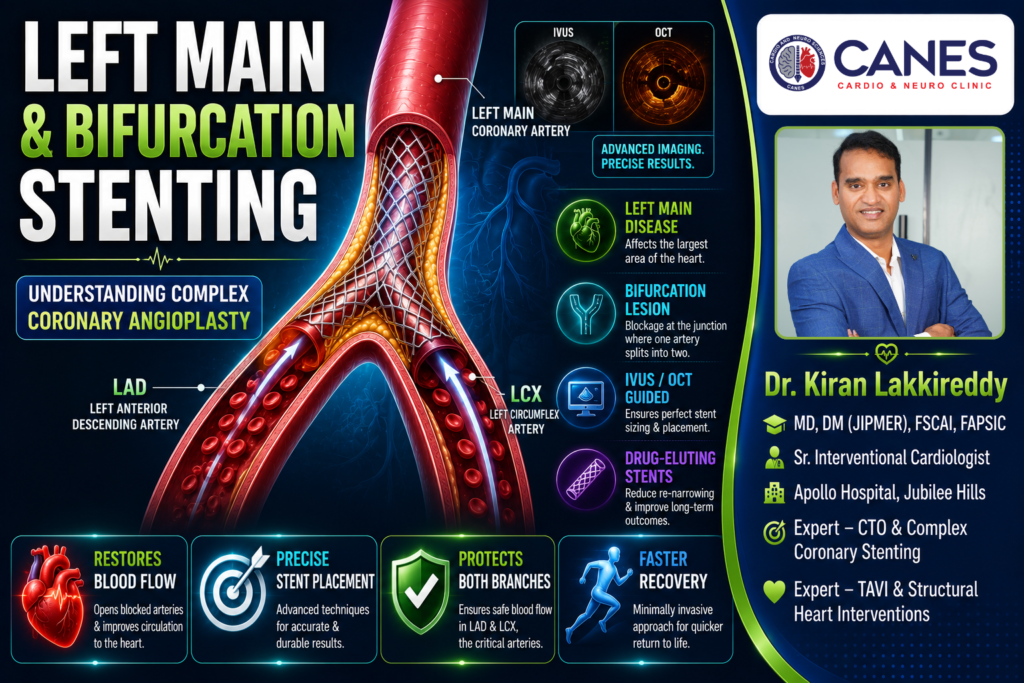
● Lifestyle & Prevention Left Main and Bifurcation Stenting: Understanding Complex Coronary Angioplasty Table of Contents Introduction Complex Stenting At a Glance What Is the Left Main Coronary Artery? What Is a Coronary Bifurcation Blockage? Why Are Left Main and Bifurcation Procedures Considered Complex? Decision Support: Should I Choose Left Main Stenting or Bypass Surgery? How Is Left Main and Bifurcation Stenting Performed? Is One Stent or Two Stents Better for a Bifurcation? Why Is IVUS Important in Left Main Stenting? Who May Not Benefit From Left Main Stenting? What Are the Possible Risks of Left Main and Bifurcation PCI? Myth vs. Fact: Complex Stenting What Should You Do Next? Advanced Cardiovascular Care at CANES Clinic Key Points to Remember FAQs Book a Consultation Prevention is better than cure. Talk to our specialists today. Book Now Coronary stenting is commonly used to open narrowed heart arteries and restore healthy blood flow. However, not every blockage is straightforward. When blockages occur in critical junctions of the heart, specialized techniques like left main and bifurcation stenting become necessary to protect your cardiovascular system. Treating these high-risk locations requires meticulous planning because the cardiologist must open the blocked artery while simultaneously protecting blood flow to every other important branch. Modern drug-eluting stents, advanced imaging, and specialized surgical techniques have made minimally invasive treatment highly successful for carefully selected patients. However, stenting is not automatically the right option for everyone; the decision must be tailored to your specific anatomy, overall health, and long-term goals. At CANES Cardio & Neuro Clinic, a specialized cardiovascular care center in Hyderabad, we believe that patients should clearly understand both their disease and their available treatment options. Guided by Dr. Kiran Lakkireddy, an experienced interventional cardiologist specializing in complex cardiology, our approach focuses on detailed assessment, shared decision-making, and structured follow-up care. In this guide, we explain exactly what left main and bifurcation stenting involves and how experts decide between placing a stent and performing bypass surgery. Quick Answer Left main and bifurcation stenting is a specialized form of coronary angioplasty used to safely treat blockages located in the heart’s primary artery or at an intersection where a vessel divides into two branches. The procedure uses advanced imaging and specialized stent placements to restore essential blood flow. Because this affects a massive area of the heart, treatment decisions are highly individualized, weighing the benefits of minimally invasive stenting against traditional bypass surgery. Complex Stenting At a Glance Feature What It Means Why It Matters Left Main Artery The primary vessel supplying the left side of the heart. A blockage here threatens a massive portion of the heart muscle. Bifurcation A “fork in the road” where one artery splits into two. Treating one branch risks accidentally shifting plaque into the other. IVUS / OCT Microscopic cameras placed inside the artery. Ensures the stent is perfectly sized and expanded for long-term safety. Provisional Stenting Placing one stent first, and a second only if needed. The safest, most common approach to keep procedures as simple as possible. What Is the Left Main Coronary Artery? The left main coronary artery is the major blood vessel beginning at the aorta that divides into the left anterior descending artery (LAD) and the left circumflex artery (LCx), supplying blood to the largest portion of the heart muscle. Key Takeaway: A left main blockage is considered extremely critical because it can threaten the blood supply to a massive area of the heart all at once, unlike a blockage in a smaller branch. Detailed Explanation Left main disease may develop at the very beginning of the artery, in its middle section, or near the intersection where it divides into the LAD and LCx. A blockage at the far end (distal end) of the left main artery is often the most complex to treat because it directly involves both branching vessels. The cardiologist must restore blood flow through the main pipe while avoiding the accidental obstruction of either the LAD or the LCx. While a standard angiogram provides a basic outline of the coronary artery, estimating the true severity of some left main blockages from an X-ray alone can be difficult. For uncertain narrowings, cardiologists rely on advanced intravascular imaging or pressure-based assessments to determine exactly how severely blood flow is being restricted. What Is a Coronary Bifurcation Blockage? A coronary bifurcation blockage is a buildup of cholesterol plaque at a junction where one main blood vessel divides into two distinct branches, creating a Y-shaped intersection. Key Takeaway: Bifurcation stenting is highly complex because inflating a balloon or opening a stent in one branch can physically push plaque into the neighboring branch, accidentally cutting off its blood supply. Detailed Explanation Imagine a major highway that divides into two important exit routes. If a road crew repairs the main highway without protecting the second route, they might accidentally push debris into the exit, closing it off completely. A similar challenge occurs during bifurcation angioplasty. When a balloon or stent expands inside the main vessel, plaque can shift (often called the “snowplow effect”) toward the side branch. The metal structure of the stent itself may also cover the opening of that branch. To prevent this, the cardiologist meticulously plans how to maintain access to both branches, select the exact right stent diameter, and confirm that blood flows freely down both “roads” before finishing the procedure. Why Are Left Main and Bifurcation Procedures Considered Complex? These procedures are considered complex because they involve treating large arteries of varying sizes, navigating challenging vessel angles, and simultaneously preserving high-volume blood flow through multiple critical pathways. Key Takeaway: Procedural success relies not just on placing a stent, but on selecting the correct architectural strategy and using advanced imaging to confirm the stent is structurally perfect. Detailed Explanation Standard stenting is often straightforward, but left main and bifurcation stenting introduces several high-stakes variables: Large Muscle Area at Risk: Left main disease dictates the blood supply for both the LAD and LCx. A mistake here affects