Introduction
Parkinson’s disease is a progressive neurological disorder that mainly affects movement, muscle control, coordination, and balance. Symptoms usually begin gradually and may initially appear as mild tremors or slowness of movement before progressing over time.
Parkinson’s disease can affect walking, posture, speech, facial expressions, and daily activities, significantly impacting quality of life if not managed properly.
At CANES Cardio & Neuro Clinic, Kondapur, advanced Parkinson’s disease evaluation and movement disorder management are provided under the expertise of Dr. Soumya Arapreddy, Consultant Neurologist, using modern neurological assessment methods and personalized treatment approaches.
The clinic focuses on accurate diagnosis, symptom control, mobility improvement, long-term neurological care, and enhancing overall quality of life for patients with movement disorders.
1. What is Parkinson’s Disease?
Parkinson’s disease develops due to gradual loss of dopamine-producing nerve cells in specific areas of the brain.
Dopamine is an important chemical responsible for smooth, coordinated, and controlled body movements. Reduced dopamine levels lead to movement-related symptoms and neurological complications associated with Parkinson’s disease.
Parkinson’s disease is a chronic progressive neurological condition that requires continuous neurological monitoring and long-term management.
Patients from Kondapur, Gachibowli, Hitech City, Madhapur, Kukatpally, Financial District, and nearby areas frequently seek neurological consultation at CANES Clinic for Parkinson’s disease treatment and movement disorder evaluation.
2. Common Symptoms of Parkinson’s Disease
Symptoms may vary from person to person and usually develop gradually over time.
Common symptoms include:
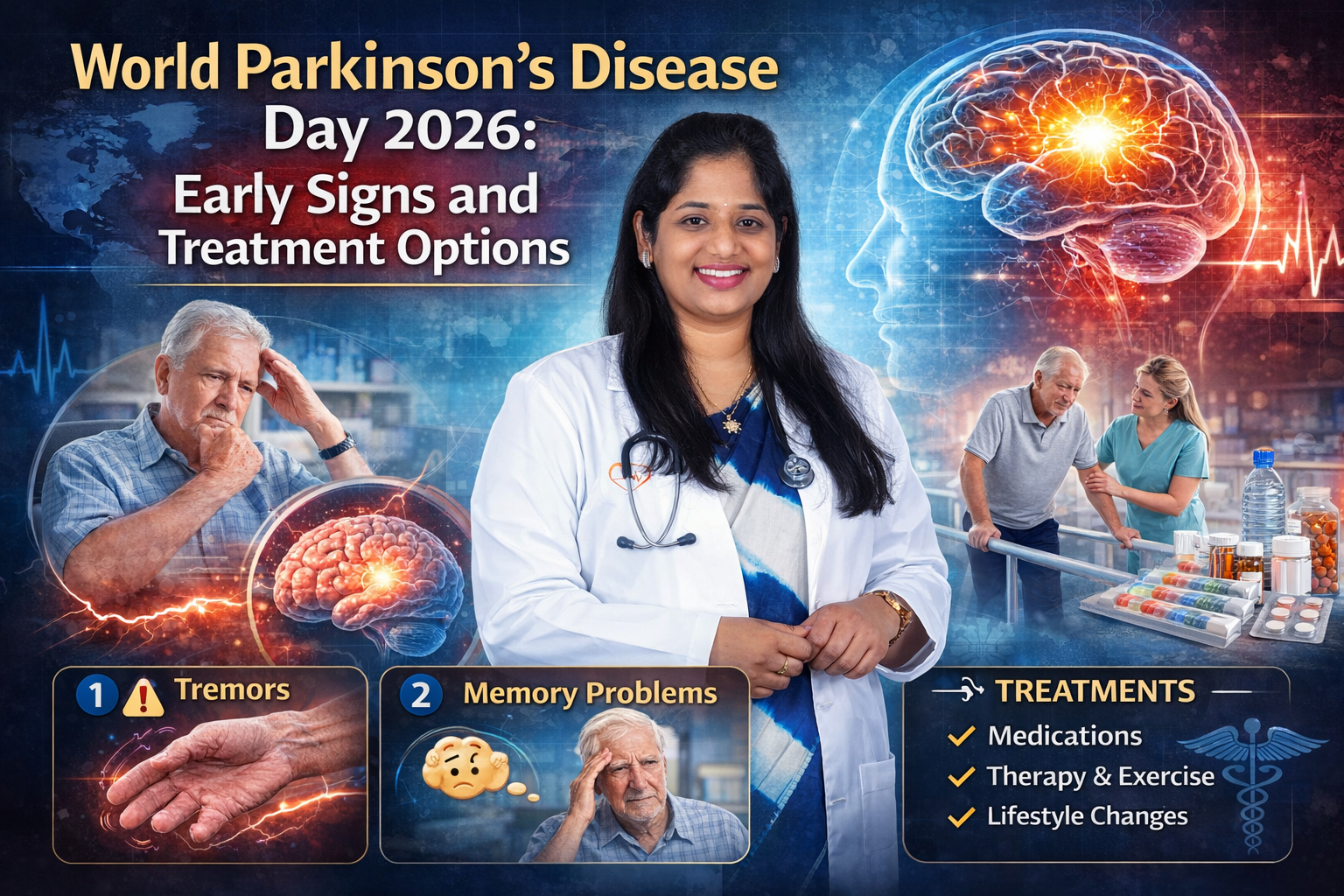
- Tremors or shaking of hands, legs, or jaw
- Slowness of movement (Bradykinesia)
- Muscle stiffness or rigidity
- Difficulty walking
- Balance and coordination problems
- Stooped or bent posture
- Reduced facial expressions
- Soft or slowed speech
- Difficulty performing daily activities
- Small handwriting changes
- Fatigue and reduced movement speed
- Depression, anxiety, or mood changes
- Memory or cognitive changes in advanced stages
Early neurological evaluation and treatment may help improve mobility, independence, and long-term quality of life.
3. What Causes Parkinson’s Disease?
The exact cause of Parkinson’s disease is not fully understood, but several factors may contribute to the condition.
Common risk factors include:
- Increasing age
- Family history of Parkinson’s disease
- Genetic factors
- Exposure to environmental toxins
- Brain injury or trauma
- Degenerative neurological conditions
Certain neurological disorders may also mimic Parkinson’s symptoms and require careful neurological evaluation for accurate diagnosis.
4. Diagnosis of Parkinson’s Disease
There is currently no single blood test or imaging test that completely confirms Parkinson’s disease.
Diagnosis mainly depends on detailed neurological assessment, movement evaluation, medical history, and characteristic symptoms.
Diagnostic evaluation may include:
- Neurological examination
- Assessment of movement and balance
- Symptom and medical history review
- MRI Brain Scan
- PET Scan in selected cases
- Evaluation of response to Parkinson’s medications
Doctors also evaluate for other neurological conditions that may resemble Parkinson’s disease.
At CANES Cardio & Neuro Clinic, advanced neurological evaluation methods are used for accurate movement disorder diagnosis and individualized treatment planning.
5. Conditions Similar to Parkinson’s Disease
Several neurological movement disorders may show symptoms similar to Parkinson’s disease.
Atypical Parkinsonian Disorders
These disorders may cause tremors, stiffness, and slowness of movement but often progress differently and may respond less effectively to standard Parkinson’s medications.
Essential Tremor
Essential tremor is a neurological condition that causes rhythmic shaking, especially during activities such as writing, eating, or holding objects.
Huntington’s Disease
Huntington’s disease is a hereditary neurological disorder causing progressive brain cell degeneration and abnormal involuntary movements.
Accurate neurological assessment is important for proper diagnosis and management of movement disorders.
6. Parkinson’s Disease Treatment
Although Parkinson’s disease cannot currently be completely cured, treatment may help control symptoms, improve movement, and maintain quality of life.
Treatment options may include:
- Parkinson’s medications such as Levodopa
- Physical therapy
- Occupational therapy
- Speech and swallowing therapy
- Lifestyle modifications
- Balance and mobility training
- Advanced neurological monitoring
- Long-term movement disorder management
Treatment plans are personalized depending on symptom severity, disease progression, and overall neurological health.
Dr. Soumya Arapreddy provides individualized Parkinson’s disease management focused on improving mobility, coordination, independence, and neurological wellness.
7. Parkinson’s Disease Prevention & Management
Although Parkinson’s disease may not always be preventable, healthy lifestyle habits may support better brain health and mobility.
Tips for managing Parkinson’s disease include:
- Exercise regularly
- Maintain healthy balanced diet
- Stay physically active
- Attend regular neurological follow-ups
- Practice balance and coordination exercises
- Maintain healthy sleep routine
- Manage stress effectively
- Follow medication schedule regularly
- Continue rehabilitation exercises
Early neurological care may help slow symptom progression and improve daily functioning.
8. When Should You Consult a Neurologist?
Neurological consultation is recommended if you experience:
- Persistent tremors or shaking
- Slowness of movement
- Muscle stiffness
- Balance or walking difficulty
- Changes in posture
- Difficulty with coordination
- Speech or swallowing difficulty
- Reduced movement affecting daily activities
Early diagnosis and neurological treatment may help improve long-term outcomes and quality of life.
9. Parkinson’s Disorder Treatment in Kondapur
CANES Cardio & Neuro Clinic provides advanced Parkinson’s disease treatment and comprehensive neurological care for patients across Kondapur, Gachibowli, Hitech City, Madhapur, Kukatpally, Financial District, and surrounding areas.
The clinic specializes in movement disorder management, tremor evaluation, stroke care, neuropathy treatment, epilepsy management, memory disorder care, vertigo evaluation, and comprehensive neurological consultation using evidence-based neurology approaches.
10. Why Choose CANES Cardio & Neuro Clinic?
Why patients choose CANES Clinic for Parkinson’s treatment:
- Advanced movement disorder evaluation
- Personalized neurological treatment plans
- Comprehensive Parkinson’s management
- Modern neurodiagnostic assessment
- Long-term neurological follow-up
- Patient-focused compassionate care
- Evidence-based neurology approach
- Convenient location in Kondapur
11. About Dr. Soumya Arapreddy
Dr. Soumya Arapreddy
MD, DM Neurology
Consultant Neurologist
Dr. Soumya Arapreddy is a Consultant Neurologist with expertise in Parkinson’s disease management, movement disorders, stroke care, migraine treatment, epilepsy management, neuropathy evaluation, memory disorders, and various neurological conditions affecting the brain, spine, nerves, and muscles.
She focuses on evidence-based neurological care, accurate diagnosis, and personalized treatment planning using modern neurology approaches and compassionate patient care.
At CANES Cardio & Neuro Clinic, Kondapur, she provides comprehensive neurological care for patients with movement disorders, Parkinson’s disease, migraine, epilepsy, neuropathy, autoimmune neurological diseases, spine disorders, and other neurological conditions.
Expertise Areas
- Stroke (Paralysis)
- Migraine
- Headache
- Epilepsy
- Neck / Back Pain
- Neuropathy
- Dementia & Alzheimer’s Disorders
- Parkinson’s Disorders
- Multiple Sclerosis Disorder
- Pediatric Neurology
- CNS Infections
- Motor Neuron Disease
- Neuromuscular Disorders
- Spinal Cord Disorders
- Trigeminal Neuralgia
- Vertigo
9. Frequently Asked Questions