
Why Headaches Increase in Summer: Symptoms, Causes, and Prevention Tips
Table of Contents
- Introduction
- 1. The Biological Catalyst: Why Do Summer Headaches Increase?
- 2. Migraine in Summer: Specific Triggers to Watch
- 3. The Hidden Culprit: Sleep Disruption and Brain Health
- 4. Heatstroke vs. Headache: Knowing the Critical Difference
- 5. Special Populations at Risk: Children and the Elderly
- 6. Nutritional Defense: Best Foods for Hydration
- 7. 7 Comprehensive Prevention Strategies
- When to See the Best Neurologist in Hyderabad
- FAQs
Book a Consultation
Prevention is better than cure. Talk to our specialists today.
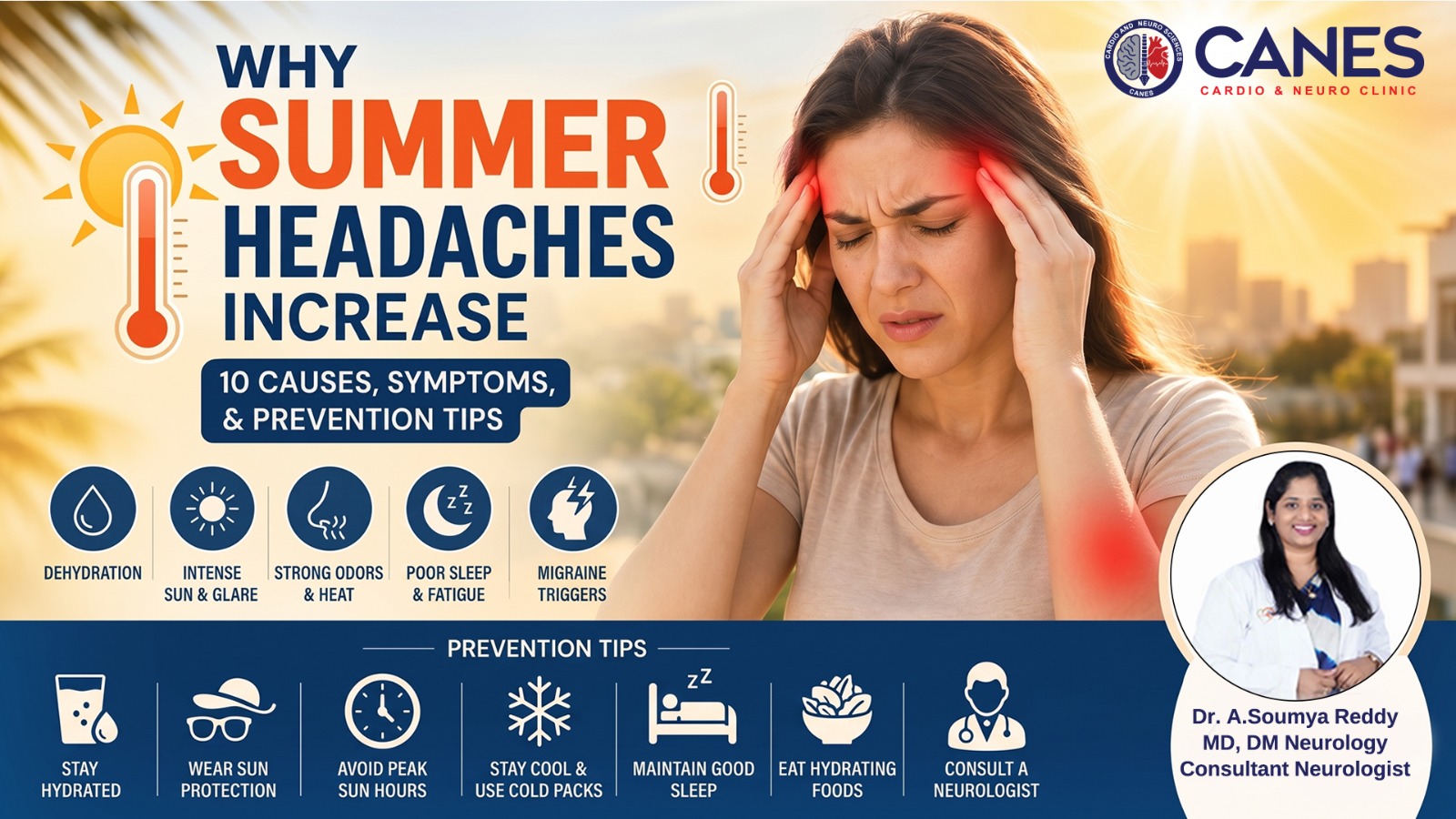
As the scorching sun takes its toll on the landscape, many individuals notice a distressing physical trend: their head pain becomes more frequent, more intense, and harder to manage. If you find yourself reaching for analgesics more often during the warmer months, you are likely dealing with the biological reality of summer headaches. This seasonal spike in neurological discomfort is not merely a coincidence; it is a complex physiological response to environmental stressors that tax the human nervous system.
At CANES Cardio & Neuro Clinic, recognized as the leading neuro clinic in Hyderabad, we observe a significant influx of patients seeking relief during the peak of the heatwave season. Guided by Dr. Soumya Reddy, widely regarded as the best neurologist in Hyderabad, our team specializes in identifying these seasonal triggers and providing comprehensive, evidence-based management strategies. This guide serves as an exhaustive resource to help you understand the science of heat-induced pain and how to protect your brain health.
1. The Biological Catalyst: Why Do Summer Headaches Increase?
The human brain is an incredibly sensitive organ that thrives on homeostasis a stable, internal equilibrium. When the external temperature climbs, the body must initiate several aggressive cooling mechanisms to protect vital organs. For individuals prone to neurological sensitivities, these cooling processes can inadvertently trigger pain pathways. Understanding how sleep disorders affect brain health or how vascular changes impact head pain is the first step toward effective management.
1. The Vascular Response: Vasodilation and Pressure
One of the primary reasons for a headache due to heat is the expansion of blood vessels. When the body gets hot, the brain signals the blood vessels to dilate (widen) to release heat through the skin. This process, known as vasodilation, increases blood flow significantly. In the confined space of the skull, this increased volume can put mechanical pressure on sensitive nerve endings, resulting in a throbbing, pulsating sensation common in a heatwave headache.
2. Dehydration and the "Brain Shrink" Phenomenon
A dehydration headache is perhaps the most frequent summer ailment. When you lose fluids through sweat without adequate replacement, your blood volume drops, and your electrolyte levels (sodium, potassium, and magnesium) become imbalanced. In extreme cases, the brain tissue can actually lose enough fluid to temporarily shrink and pull away from the skull. This physical tension triggers pain receptors, often resulting in a dull, heavy ache that worsens with movement.
2. Migraine in Summer: Specific Triggers to Watch
For those who suffer from chronic migraines, the summer months can be a “perfect storm” of triggers. A migraine in summer is often more severe because the environmental changes act as a force multiplier for existing neurological vulnerabilities. Patients with chronic migraines may benefit from a specialized neurological evaluation at our Kondapur facility.
High Intensity Sun Glare
Bright sunlight is a powerful primary trigger for summer migraine triggers. The intense glare from the sun, or even light reflecting off glass buildings and car windshields, can overstimulate the optic nerve. This overstimulation travels to the thalamus—the brain’s relay center—which then activates the trigeminal nerve system, the main pain pathway for migraines.
Pungent Odors and Heat
Heat has a way of intensifying smells. Whether it is the scent of melting asphalt, strong perfumes, or chlorine from a swimming pool, these odors become more volatile in high temperatures. For many, these intensified scents are enough to trigger a full-blown migraine attack, accompanied by nausea and sensory sensitivity.
3. The Hidden Culprit: Sleep Disruption and Brain Health
The relationship between temperature and sleep is critical to neurological stability. The brain requires a slight drop in core body temperature to initiate deep, restorative REM sleep. During hot summer nights, the body struggles to reach this cooling threshold, leading to fragmented, poor-quality rest.
Chronic sleep disruption leads to a lower pain threshold. When the brain does not get enough rest, it becomes “hyper-excitable,” meaning it overreacts to minor stimuli that it would normally ignore. This creates a vicious cycle: the heat prevents sleep, and the lack of sleep makes you more susceptible to a heat headache the following morning. Proper headache treatment often begins with stabilizing these sleep-wake cycles.
4. Heatstroke vs. Headache: Knowing the Critical Difference
It is vital to distinguish between a common heatwave headache and the much more dangerous condition of heatstroke. Heatstroke is a life-threatening medical emergency where the body’s internal cooling system fails completely.
| Feature | Summer Headache | Heatstroke (Emergency) |
| Pain Level | Throbbing or dull ache | Sudden, severe, “thunderclap” pain |
| Skin State | Sweaty and warm | Hot, dry, or red (no sweating) |
| Mentation | Clear, though irritable | Confused, disoriented, or delirious |
| Body Temp | Usually normal | High (above 104°F / 40°C) |
| Other Signs | Mild nausea | Seizures, fainting, or vomiting |
5. Special Populations at Risk: Children and the Elderly
While summer headaches can affect anyone, two groups are particularly vulnerable due to their body’s limited ability to regulate temperature.
Risks for Children
Children have a higher surface-area-to-mass ratio than adults, meaning they absorb heat from the environment much faster. Furthermore, their sweat glands are not as efficient as an adult’s. Children often forget to hydrate while playing, leading to a rapid-onset dehydration headache. Parents should watch for unusual irritability or lethargy in their children during the summer months.
Risks for the Elderly
As we age, our bodies become less efficient at sensing thirst and regulating temperature. Many elderly individuals also take medications for blood pressure or heart health that can increase the risk of dehydration. For seniors, a sudden headache in the heat should always be taken seriously, as it can be a precursor to more severe cardiovascular or stroke-related events.
6. Nutritional Defense: Best Foods for Hydration
Preventing summer headaches goes beyond just drinking plain water. You need to consume foods that provide both fluid and the essential electrolytes needed for nerve conduction.
Watermelon & Strawberries: These consist of about 91% water and provide essential antioxidants.
Cucumber & Celery: High in water content and provide a natural source of cooling minerals.
Coconut Water: Often called “Nature’s Gatorade,” it is rich in potassium and magnesium, which are critical for preventing muscle and nerve tension.
Yogurt/Curd: High in riboflavin (Vitamin B2), which has been scientifically shown to reduce the frequency of migraine attacks.
7. 7 Comprehensive Prevention Strategies
To enjoy your summer without the burden of chronic pain, you must take a proactive approach to environmental and biological management.
1. Practice “Intelligent Hydration”: Do not wait until you are thirsty. Drink small amounts of water consistently throughout the day. If you are sweating heavily, choose an ORS (Oral Rehydration Solution) to maintain electrolyte balance.
2. Wear Polarized Protection: Protect your optic nerve by wearing high-quality, polarized sunglasses that block 100% of UVA and UVB rays. A wide-brimmed hat can also keep your scalp and forehead cool.
3. The “Golden Window” for Activity: Limit outdoor activities to the early morning (before 8:00 AM) or late evening (after 6:00 PM). Avoid the peak ultraviolet intensity of the afternoon sun.
4. Cool Down the Pulse Points: If you feel a headache coming on, apply an ice pack or a cold, wet cloth to your wrists, the back of your neck, or your temples. This cools the blood flowing directly to the brain.
5. Maintain Your Internal Clock: Keep your meal and sleep times consistent. Fluctuations in blood sugar are a massive trigger for summer migraine triggers.
6. Create a Sleep Sanctuary: Use fans or air conditioning to keep your bedroom at an optimal cooling temperature (around 18-22°C). If you struggle with chronic sleep issues, seek a neurology consultation.
7. Limit Alcohol and Caffeine: Both substances are diuretics, meaning they force your body to lose water more quickly, significantly increasing the risk of a dehydration headache.
When to See the Best Neurologist in Hyderabad
Most summer headaches resolve with hydration and cooling. However, if your pain becomes a regular occurrence, it may indicate an underlying neurological sensitivity that requires professional management. You should seek an evaluation at CANES Cardio & Neuro Clinic if:
The headaches occur more than twice a week.
Over-the-counter medications no longer provide relief.
The pain is accompanied by vision changes or numbness in the limbs.
You experience a “new” type of pain that you haven’t felt before.
Dr. Soumya Reddy and her team use advanced neuro-diagnostics to pinpoint the exact cause of your discomfort, ensuring you don’t just mask the pain, but treat the root cause.
📍 Location: 3rd Floor, Tapasavi Commercial Complex, Hi-Tension Rd, Kondapur, Hyderabad.
📞 Call Us: +91 9014944654
🌐 Book an Appointment: https://canesclinic.com/
Frequently Asked Questions (FAQs)
This is caused by “thermal shock.” The sudden change in temperature causes your blood vessels to constrict and dilate rapidly, which can trigger a sudden, sharp heat headache. It is best to spend a few minutes in a non-AC area (like a balcony or hallway) to let your body adjust before stepping into the sun.
Yes. High humidity prevents sweat from evaporating off your skin, which is the body’s main way of cooling down. This causes your internal temperature to rise, leading to a headache due to heat even on overcast, humid days.
Exercise is generally good for migraines, but in the summer, you should stick to indoor, climate-controlled environments. If you must exercise outdoors, stay shaded and double your water intake to prevent a dehydration headache.
While hydration helps, drinking “ice-cold” water too quickly can sometimes cause a “brain freeze” (sphenopalatine ganglioneuralgia), which might temporarily worsen your pain. It is better to drink cool or room-temperature water steadily.
Expert Care
Hyderabad's leading Cardio & Neuro specialists.