What Is the Difference Between a Heart Attack and Heart Block?
Table of Contents
- Introduction
- 1. The Critical Distinction: Heart Attack vs. Cardiac Arrest
- 2. The 6 Hidden Causes of Sudden Cardiac Arrest in Young Athletes
- 3. Warning Signs Athletes and Coaches Should Monitor
- 4. The Importance of Advanced Sports Cardiology Screenings
- 5. The Chain of Survival: Emergency Action on the Field
- 6. Comprehensive Preventive Care at CANES Clinic
- FAQs
Book a Consultation
Prevention is better than cure. Talk to our specialists today.
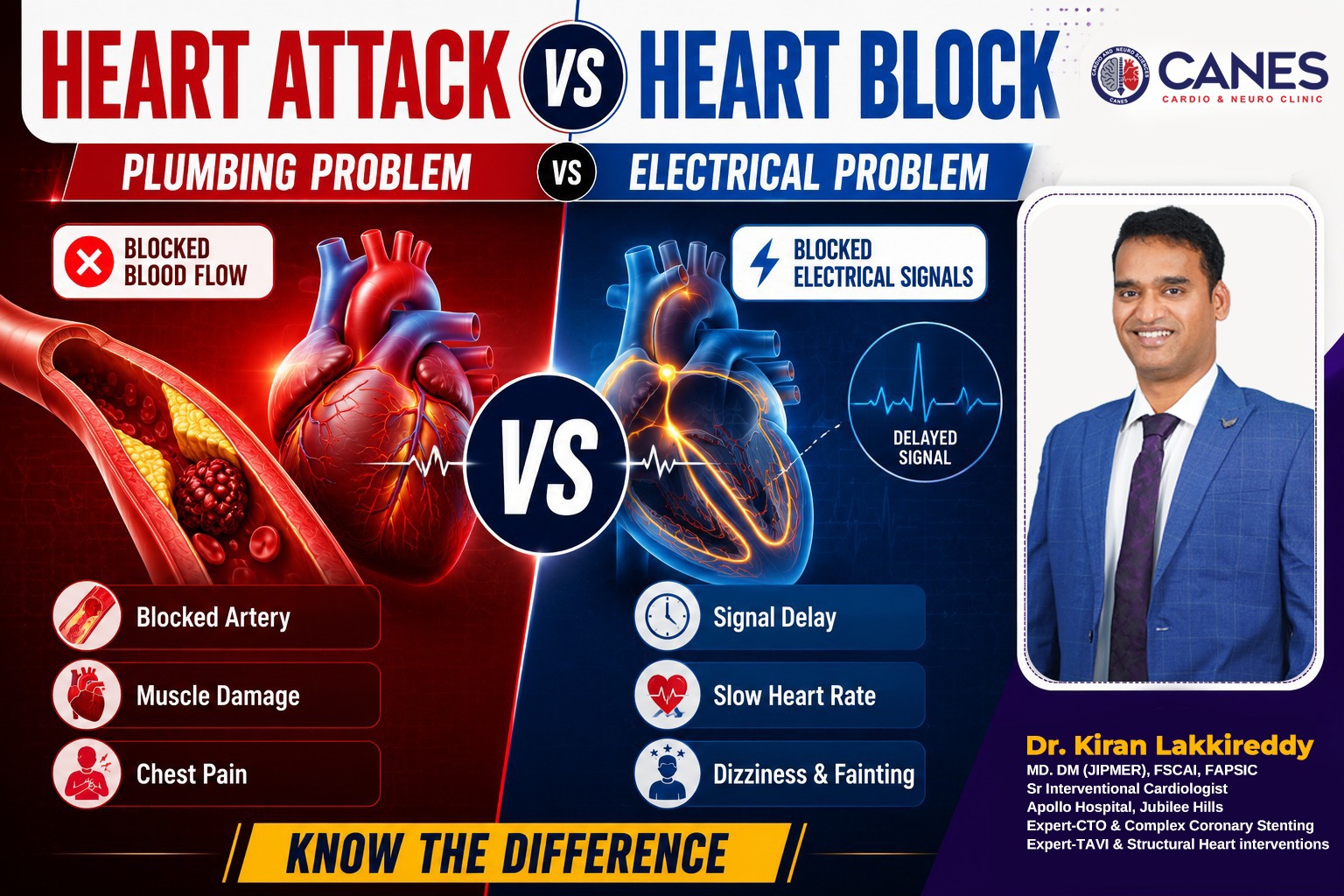
The short answer: A heart attack is a “plumbing” problem where a blocked artery stops blood flow to the heart muscle, while a heart block is an “electrical” problem where the nerve signals that tell the heart to beat are delayed or stopped.
When you sit down in a doctor’s office and hear the word “block” in relation to your heart, it is entirely natural to feel a wave of anxiety. In everyday conversation, medical terminology often gets mixed up. Because both a “heart attack” and a “heart block” involve something being obstructed, many patients assume they are dealing with the exact same illness.
However, they are two completely distinct cardiac conditions. They have different root causes, produce different physical symptoms, and require entirely different life-saving treatments. Understanding the difference between a heart attack and heart block is not just about learning medical vocabulary; it is about recognizing the right warning signs so you can seek the correct emergency care without delay.
At CANES Cardio & Neuro Clinic, recognized as the best cardiologist clinic in Hyderabad, we believe in speaking to our patients in plain, regular English. Guided by Dr. Kiran Lakkireddy, a highly trusted heart specialist, our team is dedicated to replacing fear with clear, actionable knowledge. In this comprehensive master guide, we will break down the exact differences between these two conditions, how they are diagnosed, and the modern treatments we use to fix them.
1. The Short Answer: The Plumbing vs. Electrical Analogy
To easily understand the difference, imagine your heart is a house: a heart attack is a clogged water pipe, while a heart block is a cut electrical wire.
The easiest way to grasp how your heart functions is to think of it like a well-built house. To keep a house running smoothly, you need two completely separate systems. First, you need a plumbing system (pipes) to bring fresh water into the rooms. Second, you need an electrical system (wires) to carry current to the light switches so the house can function. Your heart works the exact same way.
When we talk about a heart attack, we are talking about a catastrophic failure in the plumbing system. The blood vessels (coronary arteries) that deliver oxygen-rich blood to the heart muscle become clogged with cholesterol. On the other hand, when we talk about a heart block, we are looking at a failure in the electrical system. The internal wiring (conduction system) that sends the spark telling your heart muscle to squeeze experiences a delay or a complete break.
2. What Exactly is a Heart Attack (Myocardial Infarction)?
A heart attack is a life-threatening emergency where a ruptured cholesterol plaque forms a blood clot, completely blocking oxygenated blood from reaching a section of the heart muscle.
A heart attack is formally known in the medical world as a myocardial infarction (MI). Your heart is a working muscle, constantly pumping 24 hours a day. Like your biceps or your calf muscles, it needs a constant supply of fresh, oxygen-rich blood to survive. This blood is delivered by a network of vessels wrapped around the outside of the heart, known as the coronary arteries.
The problem begins slowly over decades. A waxy, fatty substance called cholesterol plaque builds up along the smooth inner walls of these coronary arteries—a condition we call atherosclerosis. A heart attack usually happens when one of these unstable plaques suddenly cracks or ruptures. Your body thinks this crack is an injury, so it rushes blood cells (platelets) to the area to form a clot. Unfortunately, inside a tiny artery, this clot acts like a cork in a bottle, completely blocking blood flow. The heart muscle below the blockage begins to suffocate and die, leading to permanent damage.
Recognizing the Symptoms of a Heart Attack
Heart attack symptoms are usually sudden and painful, heavily featuring crushing chest pressure, shortness of breath, and pain radiating down the arm or jaw.
Because a heart attack involves muscle tissue actively losing oxygen, the symptoms are usually related to severe physical distress. This is an absolute medical emergency. If you experience these warning signs, you must act immediately:
An intense, crushing chest pain or a feeling of heavy, squeezing pressure right in the center of your chest.
Pain or deep discomfort that radiates outward to your left arm, jaw, neck, or upper back.
Sudden, severe shortness of breath, making you feel like you cannot catch your breath even while sitting perfectly still.
Profuse, unexplainable cold sweating.
Severe nausea, vomiting, or symptoms that feel exactly like severe acid reflux or indigestion.
A sudden wave of lightheadedness or a deep, lingering feeling of impending doom.
3. What Exactly is a Heart Block (Atrioventricular Block)?
A heart block is a rhythm disorder where the electrical signals that tell the bottom chambers of the heart to beat are delayed or completely stopped, resulting in a dangerously slow pulse.
A heart block, officially called an atrioventricular (AV) block, is a condition that directly affects the electrical conduction system of the heart. For your heart to pump blood smoothly, it relies on a highly coordinated electrical spark. This spark starts in the upper right chamber at the sinoatrial (SA) node, which acts as your natural pacemaker. The signal then travels down to the atrioventricular (AV) node a gateway before spreading to the lower chambers (ventricles), telling them to squeeze and push blood out to your body.
A heart block happens when these vital electrical signals are abnormally delayed or entirely blocked at that AV node gateway. Because the message to “squeeze” isn’t getting through properly, the bottom chambers beat too slowly or out of sync. This can be caused by natural aging and scarring of the heart tissues, congenital defects you are born with, side effects from strong blood pressure medications, or even severe electrolyte imbalances.
Understanding the Three Degrees of Heart Block
Heart blocks are categorized into three levels: first-degree (mild delay), second-degree (skipped beats), and third-degree (complete electrical failure requiring immediate intervention).
Cardiologists classify this electrical issue into three specific degrees based on how severely the signal is disrupted:
First-Degree Heart Block: The electrical signal slows down as it passes through the AV node, but every single signal eventually makes it to the bottom chambers. This is very common, often harmless, and rarely causes any physical symptoms.
Second-Degree Heart Block: Some electrical signals are completely dropped at the gateway. Your heart will actually skip a beat, leading to a slower, noticeably irregular pulse that can make you feel fatigued.
Third-Degree (Complete) Heart Block: No electrical signals reach the ventricles from the top chambers. To survive, the bottom chambers rely on a backup pacemaker system, which is incredibly slow (often 30-40 beats per minute). This is highly dangerous and inadequate for keeping you conscious during physical activity.
Recognizing the Symptoms of a Heart Block
Heart block symptoms are characterized by a lack of oxygen to the brain, causing sudden dizziness, chronic fatigue, fainting spells, and an abnormally slow pulse.
Unlike a heart attack, a heart block doesn’t typically cause crushing pain because the muscle isn’t suffocating. Instead, because your heart is beating too slowly, your brain and body are not getting enough blood flow. Symptoms of a blocked electrical pathway include:
Frequent episodes of dizziness, lightheadedness, or feeling like the room is spinning.
Chronic, unexplained fatigue where you have absolutely no energy to complete normal daily tasks.
Syncope (fainting) or near-fainting spells, which often require evaluation from both a cardiologist and a neurologist to rule out brain issues.
Shortness of breath that only happens when you try to walk upstairs or do mild physical activity.
4. Side-by-Side Comparison: Myocardial Infarction vs. AV Block
While both involve blockages, heart attacks are urgent plumbing emergencies causing chest pain, whereas heart blocks are electrical issues causing a slow heart rate and fainting.
To make the difference between a heart attack and heart block perfectly clear, we use this simple, highly factual clinical comparison table.
| Feature | Heart Attack (Myocardial Infarction) | Heart Block (Atrioventricular Block) |
| The Primary Issue | Plumbing (A blocked artery stops blood flow). | Electrical (Nerve signals are delayed or stopped). |
| The Root Cause | Ruptured cholesterol plaque and a blood clot. | Tissue aging, scarring, or medication side effects. |
| Effect on Heart Rate | Often rapid (tachycardia) due to stress and adrenaline. | Abnormally slow (bradycardia) or skipped beats. |
| Primary Symptoms | Crushing chest pain, arm/jaw pain, cold sweats. | Dizziness, frequent fainting, extreme daily fatigue. |
| Medical Urgency | An absolute emergency requiring immediate hospital care. | Urgency depends on the degree; 3rd degree is critical. |
5. Can a Heart Attack Actually Cause a Heart Block?
Yes, if a heart attack blocks the specific artery that feeds blood to the heart’s electrical wiring, the lack of oxygen can damage the wiring and cause a secondary heart block.
It is very important to understand that while these are two different conditions, they can absolutely happen at the same time. In fact, a plumbing issue can directly cause an electrical issue.
Here is how it happens: The electrical nodes in your heart (like the AV node) are living tissues that need their own blood supply to function. For most people, the AV node gets its blood from a branch of the right coronary artery. If you suffer a heart attack because a massive clot forms in that right coronary artery, the AV node is suddenly starved of oxygen. When that delicate electrical tissue is damaged by the lack of blood (ischemia), it stops conducting signals properly. In this specific scenario, you experience a dangerous heart block as a direct, secondary complication of the initial heart attack.
6. How Do We Treat a Heart Attack? (Emergency Management)
Heart attacks are treated urgently by reopening the blocked artery using blood-thinning medications, balloon angioplasty, and placing a stent to restore healthy blood flow.
Managing a heart attack is a race against the clock. The primary goal is to minimize the amount of heart muscle that permanently dies. In cardiology, we frequently say “time is muscle.” As soon as you arrive at the emergency room, the medical team goes to work:
Acute Medications: You are immediately given aspirin or strong antiplatelet drugs to stop the blood clot from growing. Nitroglycerin is given to help dilate your blood vessels and ease the intense chest pain.
Reperfusion Therapy (Opening the Pipe): This is the ultimate fix. Dr. Kiran Lakkireddy specializes in Percutaneous Coronary Intervention (PCI). He threads a tiny catheter through your wrist or groin up to the blocked artery, inflates a microscopic balloon to crush the plaque, and leaves a metal mesh tube (a stent) behind to keep the artery permanently propped open.
Long-Term Rehabilitation: After the stent is placed, recovery begins. You will take daily medications like statins to aggressively lower cholesterol and beta-blockers to let the heart rest. You will also participate in cardiac rehab to slowly and safely rebuild your cardiovascular fitness.
7. How Do We Treat a Heart Block? (Rhythm Management)
Heart blocks are managed by adjusting or stopping heart-slowing medications, or in severe cases, by implanting a permanent pacemaker to keep the heart beating at a normal rate.
Treating an electrical issue requires a completely different approach. The treatment depends entirely on how severe the block is and how badly the symptoms are affecting your daily life.
Observation and Medication Adjustments: For a mild, first-degree heart block, we simply monitor your ECG yearly. If you have a second-degree block caused by taking too high a dose of a blood pressure medication (like a beta-blocker), we will simply adjust or stop that medication to let your heart rate speed back up naturally.
Permanent Pacemaker Implantation: For severe, third-degree heart blocks, medication cannot fix the broken wiring. The permanent solution is a pacemaker. This is a small, highly sophisticated device we implant just under the skin near your collarbone. It has thin wires that drop down into your heart chambers. The pacemaker acts as an intelligent backup system. It watches your heart, and if it notices that your natural electrical signal has dropped, it instantly sends a painless micro-shock to the bottom chamber, forcing it to squeeze right on time.
8. Prevention Strategies for Overall Heart Health
You can prevent both plumbing and electrical heart issues by adopting a plant-heavy diet, exercising daily, managing chronic stress, and prioritizing high-quality sleep.
While you cannot change your genetics or completely stop the aging process of your electrical pathways, you have massive control over your vascular health. Keeping your arteries clean is the best way to ensure your heart muscle and its electrical nodes stay healthy.
Dietary Choices: Focus on a Mediterranean-style diet. Drastically reduce highly processed foods and trans fats, which directly build the cholesterol plaques that cause heart attacks.
Consistent Movement: Aim for 30 minutes of brisk walking or moderate exercise every day. This keeps your blood vessels flexible and helps lower your resting blood pressure.
Neurological and Sleep Health: Chronic stress and poor sleep directly damage the heart. Untreated sleep apnea puts enormous electrical strain on the heart at night. If you snore heavily or wake up exhausted, consulting with a neurology or sleep specialist is vital for preventing future cardiac arrhythmias.
9. Why Choose CANES Clinic for Your Heart Health?
CANES Clinic offers comprehensive care from the best cardiologist in Hyderabad, combining advanced interventions with personalized, conversational care to heal your heart and brain.
Whether you are dealing with the frightening aftermath of a blocked artery or navigating the confusing symptoms of a slow, electrical rhythm disorder, expert medical guidance is non-negotiable. Symptoms like chest tightness, unexplainable fatigue, or sudden fainting should never be ignored or brushed off as just “getting older.”
At CANES Cardio & Neuro Clinic, recognized as a leading heart and brain clinic in Hyderabad, we treat the whole patient. Dr. Kiran Lakkireddy provides state-of-the-art diagnostics and minimally invasive treatments for complex cardiac issues. Furthermore, by working closely with Dr. Soumya Reddy, a premier neurologist, we ensure that complex symptoms involving both the heart and the brain (like fainting spells) are diagnosed accurately under one roof. We take pride in explaining your health to you in regular, easy-to-understand English so you can make confident decisions about your care.
📍 Location: 3rd Floor, Tapasavi Commercial Complex, Hi-Tension Rd, Kondapur, Hyderabad
📞 Call Us: +91 9014944654
🌐 Book an Appointment: Visit the CANES Clinic Website
Frequently Asked Questions (FAQs)
While severe anxiety can flood your body with adrenaline and cause a rapid, pounding heartbeat, it does not cause the physical tissue scarring or electrical delays that create a true heart block.
A:
Modern pacemakers are highly reliable, with batteries typically lasting between 7 to 12 years depending on usage. When the battery runs low, the generator under your collarbone is simply swapped out during a minor outpatient procedure.
A:
While diet doesn’t directly fix electrical wiring, adopting a heart-healthy diet prevents cholesterol plaque from building up, ensuring your heart’s electrical nodes continue receiving the rich blood supply they need to function.
Expert Care
Hyderabad's leading Cardio & Neuro specialists.