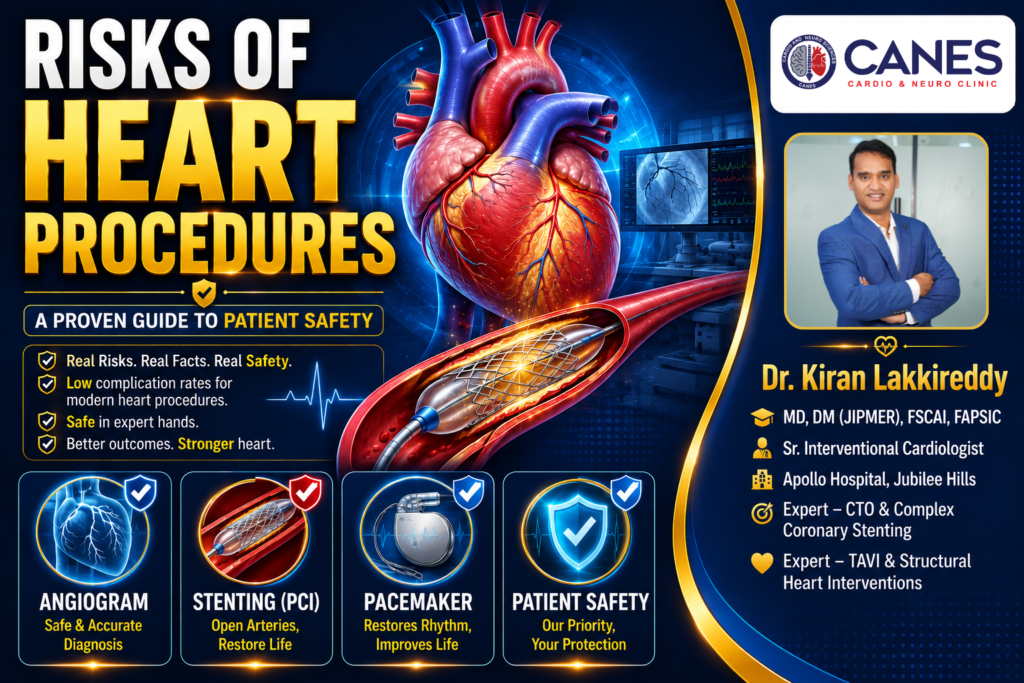
Risks of Heart Procedures: A Proven Guide to Patient Safety
● Lifestyle & Prevention Risks of Heart Procedures: A Proven Guide to Patient Safety Table of Contents Introduction Should I Be More Worried About the Procedure or the Heart Disease Itself? What Are the Real Risks of Heart Procedures? What Is a Diagnostic Cardiac Catheterisation? What Are the Risks of Angioplasty and Stenting (PCI)? Why Are High-Risk PCI Procedures Different? What Are the Risks of a Permanent Pacemaker? How Do ICD and CRT Devices Compare to Pacemakers? What Is TAVI and What Are Its Safety Rates? What Is MitraClip Valve Repair? What Are the Risks of the Watchman Device (LAAO)? The Patient Safety Checklist: Preparing for Your Procedure What Questions Should You Ask Your Cardiologist? Expert Cardiac Care at CANES Clinic FAQs Book a Consultation Prevention is better than cure. Talk to our specialists today. Book Now If your cardiologist has recommended an intervention, it is entirely natural to feel anxious about the risks of heart procedures. When you hear medical terms like “complications” or “surgery,” the fear of the unknown can quickly become overwhelming. However, when we look closely at the actual medical data, the numbers are incredibly reassuring. Most modern cardiac interventions are minimally invasive, highly routine, and designed with your long-term safety as the absolute top priority. By understanding exactly what these procedures involve and looking at the real chances of complications based on published medical research, you can replace fear with confident, informed decision-making. At CANES Cardio & Neuro Clinic, guided by Dr. Kiran Lakkireddy, we believe in absolute transparency. This comprehensive guide will clearly explain the anatomical purpose of each treatment, the published statistics, and the specific safety protocols your care team uses to protect you. Quick Answer While all medical interventions carry some level of risk, the risks of heart procedures are generally very low for planned, routine cases. On average, diagnostic tests and standard stenting have a major complication rate of less than 1%. Modern cardiology relies heavily on minimally invasive catheter techniques, which significantly reduce the chances of severe bleeding, infection, and prolonged recovery compared to traditional open-heart surgery. Should I Be More Worried About the Procedure or the Heart Disease Itself? For most patients, untreated heart disease carries a significantly greater risk of permanent disability or death than the actual procedure designed to treat it. Key Takeaway: The risks of heart procedures are closely managed and monitored by a medical team, whereas the progression of an untreated blocked artery or a failing valve is highly unpredictable and often fatal. It is completely normal to focus on the immediate anxiety of entering a hospital. However, it is vital to weigh that short-term anxiety against the long-term reality of your condition. If a cardiologist recommends a stent or a valve repair, it is because your heart is currently in a dangerous, unstable state. Declining a necessary intervention means leaving a severe blockage or electrical fault untreated. This dramatically increases your daily risk of suffering a sudden, massive heart attack, developing irreversible heart failure, or experiencing a fatal cardiac arrest. Medical interventions are recommended only when the benefit of fixing the heart overwhelmingly outweighs the statistical risk of the procedure. What Are the Real Risks of Heart Procedures? The real risks of heart procedures depend entirely on your specific heart condition, your age, and whether the procedure is planned or an emergency. However, on average, the risk of a major complication for a routine intervention is exceptionally low, often sitting below 1%. Key Takeaway: The complication numbers you see online are population averages; your personal risk may be much lower, which is why your care team takes specific steps to keep those numbers as low as possible for you. When reading through this guide, remember that numbers can be reassuring once you see them in proper medical context. A 1% risk means that out of 100 people, 99 experience absolutely no severe issues. Furthermore, your cardiology team spends extensive time planning your specific procedure to mitigate any personal health challenges, such as existing kidney issues or a history of bleeding. Visual Scale: Procedure Risk Levels To help put things into perspective quickly, here is how cardiologists generally classify the risk levels of common interventions. Procedure Average Risk Level Diagnostic Angiogram Very Low Routine PCI (Stenting) Low Permanent Pacemaker Low TAVI (Valve Replacement) Moderate High-Risk PCI Higher What Is a Diagnostic Cardiac Catheterisation? A diagnostic cardiac catheterisation (angiogram) is a test where a thin tube is guided through your wrist or groin, and contrast dye is injected to make your arteries show up clearly on an X-ray. It lets your doctor see exactly where any blockages are. Key Takeaway: This is the most basic heart procedure and is often the very first step before anything else is done, carrying a mortality risk of just 0.05–0.1% in planned cases. This is a very safe procedure. The risk of mortality is around 0.05–0.1% for planned (elective) cases, rising to about 1% only in emergency situations. A heart attack or stroke during the test is similarly rare at 0.05–0.1%. The more common issues are minor. Bruising or a small lump at the access site occurs in 1–3% of people having the test through the groin, and less than 0.5% through the wrist (which is why many doctors prefer using the wrist). Some people have a mild allergic reaction to the contrast dye—about 1–3%—though severe reactions are extremely rare. The dye can also occasionally affect your kidneys temporarily, more so if you already have kidney problems. What Are the Risks of Angioplasty and Stenting (PCI)? Percutaneous Coronary Intervention (PCI) is a procedure where a small balloon is inflated to open a blocked artery, and a stent (a tiny mesh tube) is left in place to keep the artery open. It restores blood flow without open-heart surgery. Key Takeaway: For planned PCI in stable patients, the risk of death is exceptionally low, around 0.1–0.5%. It remains the safest and most effective way to clear a blocked artery. If the