Why Sudden Cardiac Arrest Happens in Young Athletes: 6 Hidden Causes
Table of Contents
- Introduction
- 1. The Critical Distinction: Heart Attack vs. Cardiac Arrest
- 2. The 6 Hidden Causes of Sudden Cardiac Arrest in Young Athletes
- 3. Warning Signs Athletes and Coaches Should Monitor
- 4. The Importance of Advanced Sports Cardiology Screenings
- 5. The Chain of Survival: Emergency Action on the Field
- 6. Comprehensive Preventive Care at CANES Clinic
- FAQs
Book a Consultation
Prevention is better than cure. Talk to our specialists today.
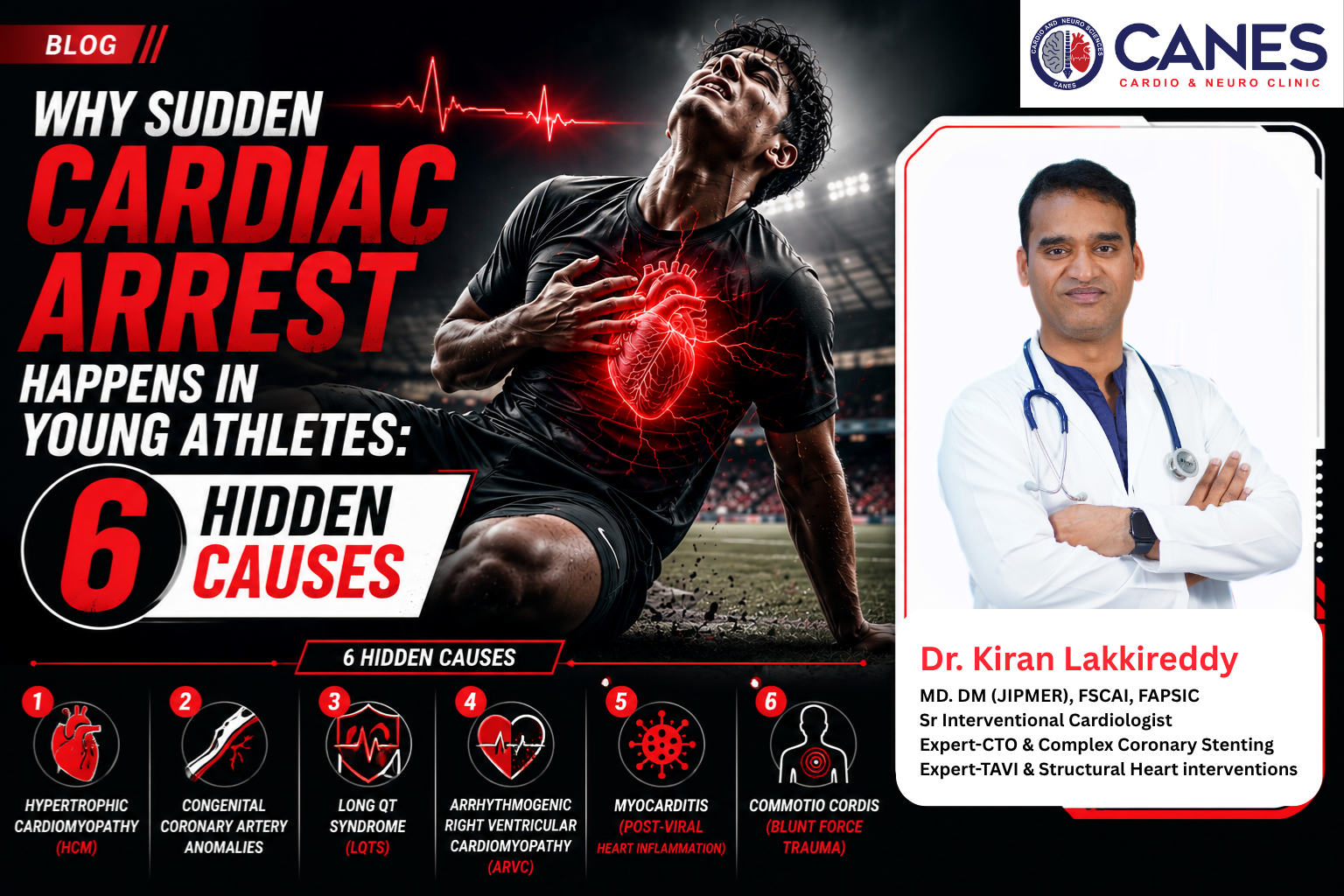
There are few medical events as concerning as a young, seemingly well-conditioned athlete collapsing on the playing field. To the general public, athletes represent the peak of physical health and cardiovascular endurance. Therefore, when sudden cardiac arrest in young athletes occurs, it challenges common assumptions about health, leaving families, coaches, and communities seeking clear medical answers.
At CANES Cardio & Neuro Clinic, recognized as a leading heart and brain clinic in Hyderabad, we believe that demystifying these events is the first step toward effective prevention. Guided by Dr. Kiran Lakkireddy, a top cardiologist in Hyderabad with over 15 years of expertise in complex cardiac care, our clinic advocates for advanced sports cardiology and proactive screenings.
In this comprehensive medical guide, we will break down the physiological reasons why sudden cardiac arrest in young athletes occurs, the underlying genetic conditions that often evade standard physicals, the warning signs that warrant attention, and the screening protocols designed to protect athletes.
1. The Critical Distinction: Heart Attack vs. Cardiac Arrest
To understand why athletes collapse, it is necessary to correct a widespread public misconception: a cardiac arrest is distinct from a heart attack.
A heart attack is primarily a circulatory problem. It occurs when a coronary artery becomes blocked by cholesterol plaque, cutting off blood flow to a section of the heart muscle. This is typically a condition associated with older age, poor diet, and long-term lifestyle factors.
A cardiac arrest, however, is an electrical problem. It occurs when the heart’s internal electrical system malfunctions, causing the heart to beat chaotically (ventricular fibrillation) or stop beating entirely. The heart immediately ceases pumping blood to the brain and vital organs, causing the individual to lose consciousness. Without immediate CPR and defibrillation, it progresses rapidly.
When a young, fit athlete collapses, it is almost exclusively an electrical failure triggered by a hidden structural or genetic abnormality.
2. The 6 Hidden Causes of Sudden Cardiac Arrest in Young Athletes
Why does the electrical system fail in a young, healthy heart? The intense physical exertion, adrenaline spikes, and dehydration associated with competitive sports can act as a catalyst, triggering pre-existing but undetected conditions. Here are the six primary causes:
1. Hypertrophic Cardiomyopathy (HCM)
Hypertrophic Cardiomyopathy is the leading medical cause of sudden cardiac arrest in young athletes. HCM is an inherited genetic condition characterized by the abnormal thickening and stiffening of the muscular walls of the heart’s left ventricle.
While the heart may appear larger on an x-ray, this thickened muscle is disorganized at a cellular level. As the muscle thickens inward, it severely limits the volume of blood the heart chamber can hold and physically obstructs blood flow out of the heart during intense exercise.
Furthermore, this abnormal, disorganized muscle tissue is highly susceptible to electrical misfires. During peak physical exertion, these misfires can trigger dangerous arrhythmias.
2. Congenital Coronary Artery Anomalies
Some individuals are born with coronary arteries that are routed abnormally. Instead of resting securely on the surface of the heart, an anomalous artery might be situated between two main chambers or large blood vessels.
During intense physical exertion, the heart expands and requires more oxygen. This expansion can physically compress the misplaced artery, suddenly reducing blood supply to the heart muscle. This acute lack of oxygen can trigger an electrical arrest.
3. Long QT Syndrome (LQTS)
Long QT Syndrome is an inherited electrical disorder. The heart’s electrical system requires a precise, measured amount of time to “recharge” between beats. In patients with LQTS, this recharging phase is abnormally prolonged.
The danger arises when the heart rate increases rapidly. When an athlete with LQTS experiences a sudden surge of adrenaline such as sprinting to the finish line, reacting to a starting gun, or diving into cold water the heart’s rhythm can destabilize.
This destabilization can trigger a severe arrhythmia, such as ventricular fibrillation, leading to a sudden loss of consciousness.
4. Arrhythmogenic Right Ventricular Cardiomyopathy (ARVC)
ARVC is a rare genetic condition where the healthy muscle tissue of the heart’s right ventricle gradually breaks down and is replaced by fatty, fibrous scar tissue.
This encroaching scar tissue directly disrupts the heart’s normal electrical pathways, creating a high risk for arrhythmias.
Research indicates that intense, endurance-based sports (like marathon running, rowing, or competitive cycling) place significant mechanical strain on the right ventricle. This strain can accelerate the progression of ARVC, making athletic participation a high-risk activity for those with the gene.
5. Myocarditis (Post-Viral Heart Inflammation)
Unlike genetic conditions, myocarditis is an acquired condition. It involves the inflammation of the heart muscle, typically caused by a recent viral infection (such as influenza, COVID-19, or Coxsackievirus).
If an athlete resumes intense training before the viral inflammation has fully resolved, the swollen and irritated heart cells are placed under immense stress. This stress can disrupt the electrical stability of the heart, leading to a sudden cardiac event.
6. Commotio Cordis (Blunt Force Trauma)
Commotio cordis is a physical phenomenon rather than a pre-existing disease. It occurs when an athlete sustains a blunt, forceful impact directly to the chest such as being struck by a baseball, a hockey puck, or a lacrosse ball.
If this specific impact occurs at a precise 20-millisecond window during the heart’s electrical cycle (the repolarization phase), the mechanical force can instantly send the heart into ventricular fibrillation.
3. The Importance of Advanced Sports Cardiology Screenings
The standard physical examination required by most athletic programs generally involves listening to the heart with a stethoscope. While helpful, this basic exam is often inadequate for detecting silent electrical and structural heart diseases.
To properly assess the risk of sudden cardiac arrest in young athletes, advanced screening is recommended. At the leading heart and brain clinic in Hyderabad, our sports cardiology protocol includes:
A 12-Lead Electrocardiogram (ECG): This non-invasive test maps the heart’s electrical pathways, helping to detect disorders like Long QT Syndrome, ARVC, or pre-excitation syndromes.
A 2D Echocardiogram: An ultrasound of the heart that provides detailed visual data on muscle thickness (ruling out HCM) and confirms proper valve function and structural integrity.
4. The Chain of Survival: Emergency Action on the Field
If a collapse occurs, the response time is critical. Survival rates drop significantly for every minute that passes without intervention. The standard emergency protocol includes:
Recognize: If an athlete drops suddenly and is unresponsive, assume a cardiac event.
Call: Alert emergency medical services immediately.
Perform CPR: Initiate hands-only CPR to manually pump blood to the brain and vital organs.
Use an AED: An Automated External Defibrillator is the definitive tool to restore a normal heart rhythm. Athletic facilities should have accessible AEDs, and staff should be trained in their use.
5. Comprehensive Preventive Care at CANES Clinic
If your child is engaged in competitive sports, ensuring their cardiovascular system is structurally and electrically sound provides vital reassurance and safety.
At CANES Cardio & Neuro Clinic, Dr. Kiran Lakkireddy utilizes advanced diagnostic imaging to evaluate young athletes. Our goal is to identify risks early, provide evidence-based guidance, and ensure athletes can participate safely in the sports they love.
“Any unexplained fainting episode during exercise should never be ignored,” says Dr. Kiran Lakkireddy.
📍 Location: 3rd Floor, Tapasavi Commercial Complex, Hi-Tension Rd, Kondapur, Hyderabad
📞 Call Us: +91 9014944654
🌐 Book an Appointment: https://canesclinic.com/
Frequently Asked Questions (FAQs)
A: While not legally mandated in all regions, global cardiology associations and preventive health organizations strongly recommend that competitive athletes undergo a baseline ECG screening at least once during their teenage years to rule out undetected genetic conditions.
A: Prevention relies on the use of certified, impact-absorbing chest protectors for players in high-risk positions (such as catchers or batters). Additionally, coaching players on proper mechanics to turn their bodies and avoid direct, frontal chest impacts is a necessary safety strategy.
Expert Care
Hyderabad's leading Cardio & Neuro specialists.