Why Do Most Heart Attacks Occur in the Early Morning? 5 Common Reasons
Table of Contents
- Introduction
- 1. The Sudden Surge of Stress Hormones
- 2. Dangerous Spikes in Blood Pressure
- 3. Increased Blood Platelet "Stickiness"
- 4. Sluggish Clot-Busting Defenses
- 5. Undiagnosed Obstructive Sleep Apnea (OSA)
- 6. How to Protect Yourself from the Morning Surge
- FAQs
Book a Consultation
Prevention is better than cure. Talk to our specialists today.
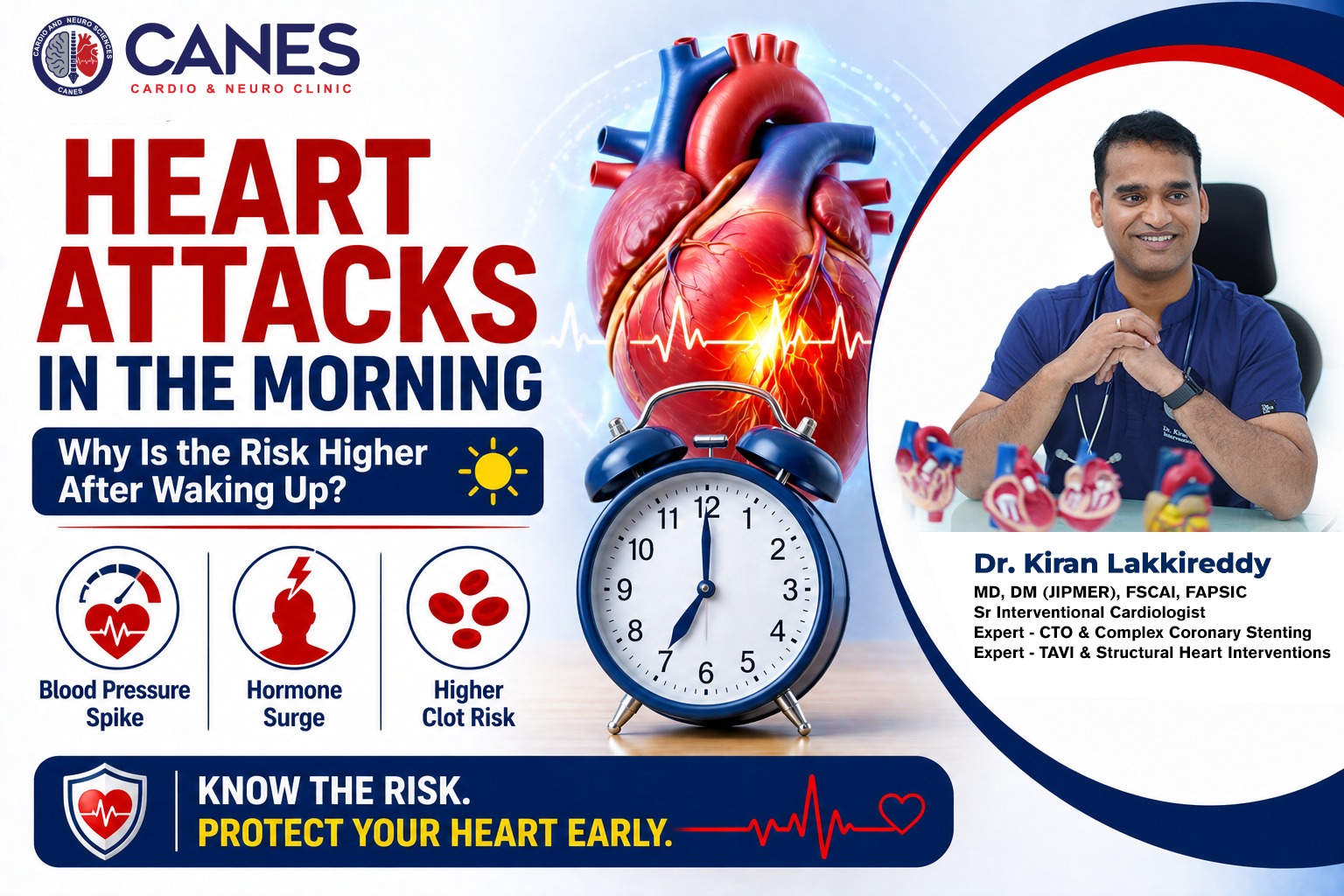
Cardiovascular statistics reveal a frightening reality: the risk of suffering a cardiac event is not distributed evenly throughout the day. In fact, medical data shows that you are significantly more likely to experience a cardiovascular emergency between the hours of 6:00 AM and noon. This phenomenon, widely known in the medical community as the “morning surge,” makes understanding why heart attacks in the early morning occur a critical component of cardiovascular health.
At CANES Cardio & Neuro Clinic, recognized as a leading heart and brain clinic in Hyderabad, we believe that proactive education saves lives. Your body undergoes massive physiological shifts as it transitions from deep sleep to wakefulness. For a healthy individual, this transition is seamless. However, for someone with underlying coronary artery disease, this “reboot” sequence can trigger a life-threatening crisis.
In this comprehensive guide, Dr. Kiran Lakkireddy, a top cardiologist in Hyderabad, breaks down the five most common biological reasons for this morning danger zone and what you can do to protect your heart.
1. The Sudden Surge of Stress Hormones
The human body operates on a natural 24-hour internal clock known as the circadian rhythm. To help you wake up and prepare for the physical demands of the day, your body begins releasing a surge of stress hormones primarily cortisol, adrenaline, and noradrenaline in the early hours of the morning.
While these hormones give you the necessary energy to get out of bed, they also put an immediate strain on your cardiovascular system. Adrenaline causes the heart to beat faster and with more force. For someone with weakened heart muscles or existing arterial plaque, this sudden demand for increased oxygen and energy can trigger heart attacks in the early morning.
2. Dangerous Spikes in Blood Pressure
As you move from a horizontal, resting position to standing upright, your autonomic nervous system must rapidly adjust to keep blood flowing to your brain against the force of gravity. This results in a sharp, sudden spike in blood pressure.
This morning blood pressure surge puts immense mechanical stress on the inner walls of your arteries. If you have vulnerable, cholesterol-filled plaques built up inside your coronary arteries, this sudden pressure wave can cause a plaque to rupture. When a plaque ruptures, the body attempts to heal it by forming a blood clot, which can completely block blood flow to the heart muscle.
3. Increased Blood Platelet "Stickiness"
Blood chemistry changes significantly depending on the time of day. Research indicates that blood platelets the microscopic cell fragments responsible for clotting are at their highest level of “stickiness” during the early morning hours.
Evolutionarily, this thick, sticky blood may have protected our ancestors from excessive bleeding if they were injured while hunting at dawn. In the modern world, however, sticky platelets are a severe liability. If a plaque ruptures during the morning surge, these highly reactive platelets will quickly form a massive, aggressive clot, making heart attacks in the early morning far more likely.
4. Sluggish Clot-Busting Defenses
Your body has a natural defense mechanism called the fibrinolytic system, which is responsible for breaking down dangerous blood clots before they can cause a blockage. Unfortunately, the efficiency of this system also fluctuates with your circadian rhythm.
Studies show that your body’s ability to naturally dissolve clots is at its absolute lowest point during the early morning. Therefore, if a clot forms due to a ruptured plaque and sticky platelets, your body is biologically least equipped to break it down between the hours of 6:00 AM and 10:00 AM.
5. Undiagnosed Obstructive Sleep Apnea (OSA)
Sleep apnea is a common but highly dangerous condition where a person repeatedly stops breathing for short periods throughout the night. These pauses in breathing cause oxygen levels in the blood to plummet, sending the body into a state of panic.
To compensate for the lack of oxygen, the brain triggers a massive release of adrenaline, drastically raising blood pressure while you are still asleep. By the time morning arrives, the heart has already endured hours of intense, oxygen-deprived stress. This nocturnal strain is a massive catalyst for early morning cardiac events.
6. How to Protect Yourself from the Morning Surge
While you cannot stop your biological clock, you can minimize the impact of the morning surge. A top cardiologist in Hyderabad will often recommend the following protective measures:
1. Don’t Rush Out of Bed: Set your alarm 10 minutes early. Sit on the edge of your bed, stretch gently, and allow your blood pressure to stabilize before standing up.
2. Hydrate Immediately: Drink a full glass of water as soon as you wake up to help thin your blood and reduce platelet stickiness.
3. Optimize Medication Timing: Discuss taking your blood pressure medications at bedtime with your doctor. Chronotherapy (timing medication to your body clock) can help blunt the morning surge.
4. Treat Sleep Apnea: If you snore loudly or wake up fatigued, undergo a sleep study. Using a CPAP machine can drastically lower your risk of morning cardiac events.
World-Class Preventive Care at CANES Clinic
Do not wait for an emergency to prioritize your cardiovascular health. At CANES Cardio & Neuro Clinic, a leading heart and brain clinic in Hyderabad, we specialize in identifying hidden risks before they result in a crisis. Through advanced screenings like Ambulatory Blood Pressure Monitoring and 2D Echo imaging, we can map your exact cardiovascular health.
Take the first step toward a safer, healthier heart today.
📍 Location: 3rd Floor, Tapasavi Commercial Complex, Hi-Tension Rd, Kondapur, Hyderabad
📞 Call Us: +91 9014944654
🌐 Book an Appointment: https://canesclinic.com/
Frequently Asked Questions (FAQs)
Expert Care
Hyderabad's leading Cardio & Neuro specialists.